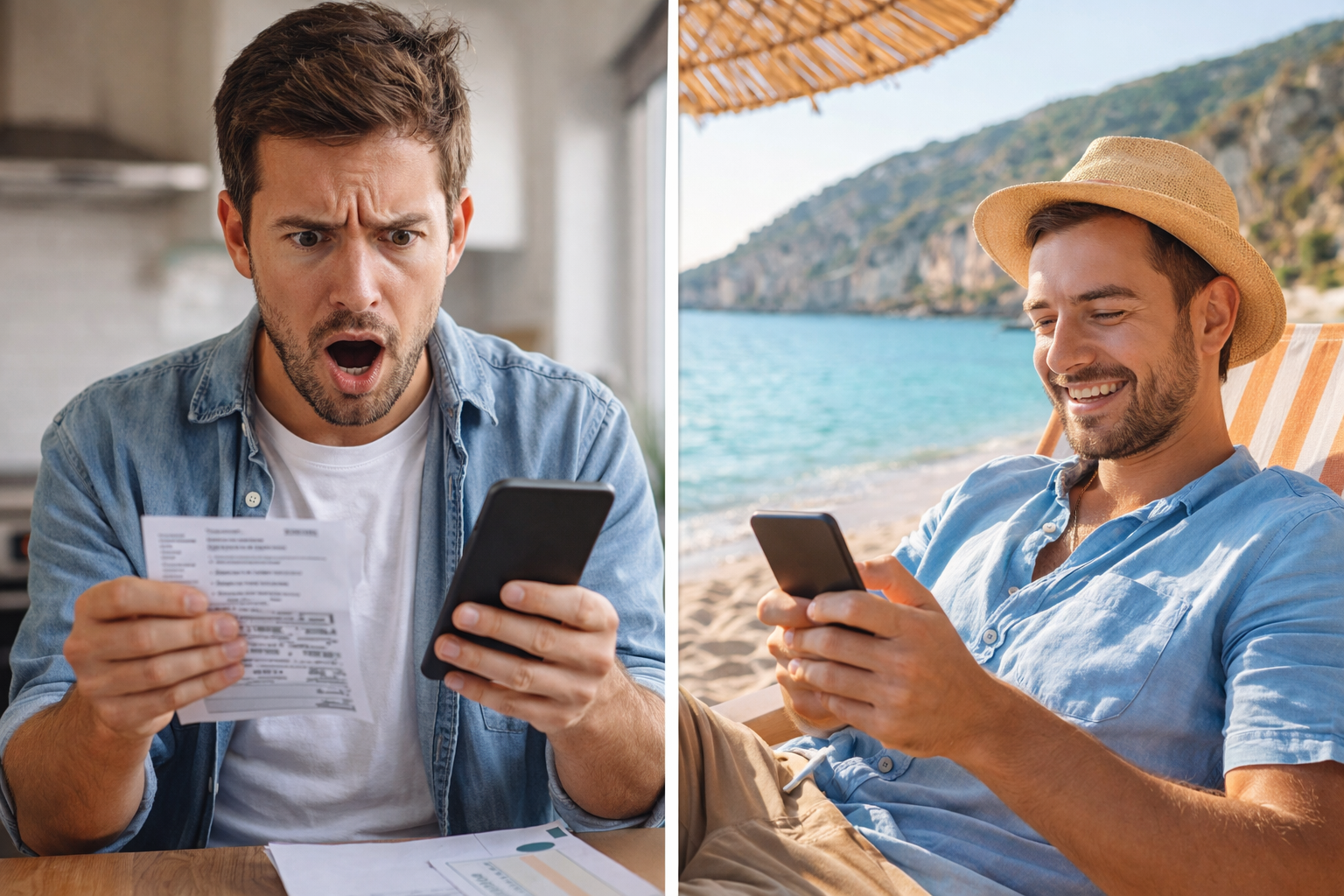
You're planning a trip and wondering: should I just use my carrier's roaming or is an eSIM worth it? The short answer: in most cases, an eSIM saves you significant money. But there are some exceptions. Here's the complete comparison to help you decide.
How does roaming work?
With roaming, you use a local network abroad through your home carrier's contract. Your provider (e.g. Swisscom, Sunrise, Salt, Vodafone, O2) charges you for the data you use – often at rates much higher than your regular plan.
Since the EU roaming regulation, roaming fees have been eliminated within EU countries. But: Switzerland is not part of this regulation, and popular destinations like Albania, Kosovo, Turkey and the USA are not covered either. This means roaming in these countries can cost several francs per megabyte.
The big comparison
| eSIM | Carrier Roaming | |
|---|---|---|
| Price (e.g. 5 GB Albania) | CHF 8–15 | CHF 50–100+ |
| Activation | Instant via QR code | Automatic (can be a cost trap) |
| Cost control | ✅ Fixed price, no surprises | ⚠️ Unexpected charges possible |
| Balkans coverage | ✅ Albania, Kosovo, etc. | ❌ Often not covered or very expensive |
| Your number | ✅ Stays active (Dual-SIM) | ✅ Stays active |
| Contract | None, prepaid | Tied to existing plan |
When does roaming make sense?
Roaming can be a reasonable option when:
- You only need a few minutes of data (e.g. a brief airport layover)
- Your mobile plan already includes roaming for your destination country at no extra cost
- You're traveling within the EU and have an EU contract with included EU roaming
- You barely use mobile data at all (relying mostly on hotel WiFi)
When is an eSIM the better choice?
An eSIM is almost always worth it, especially when:
- You're traveling to non-EU countries (Albania, Kosovo, Turkey, USA, Asia, Africa)
- You need lots of data (navigation, social media, video calls, sharing photos)
- You want full cost control – a fixed price with no surprise charges on your phone bill
- You're visiting multiple countries – a regional package saves you from buying data in each country
- You're traveling from Switzerland – Swiss roaming rates are generally higher than EU ones
- You want to avoid bill shock – with an eSIM, you pay upfront and that's it
Real cost comparison: Albania trip (1 week)
| eSIM (3 GB) | Carrier Roaming | |
|---|---|---|
| Navigation (Google Maps) | ✅ Included | ~CHF 15 |
| WhatsApp & Social Media | ✅ Included | ~CHF 25 |
| Uploading photos | ✅ Included | ~CHF 20 |
| Total | ~CHF 8 | ~CHF 60+ |
Savings with eSIM: over 80%
Common roaming traps to avoid
- Automatic roaming – your phone connects to foreign networks automatically as soon as you land, even if you didn't intend to use data
- Background apps – app updates, cloud sync, email refresh and social media all consume data silently in the background
- Kosovo/Albania not in EU – many travelers assume EU roaming covers all of Europe, but Kosovo and Albania are not included
- Daily fees – some carriers charge a flat daily rate even if you only use 1 MB that day
- Delayed billing – you might not see the roaming charges until your next phone bill, weeks later
How to avoid high roaming costs
- Buy an eSIM before your trip – it takes just 5 minutes
- Disable data roaming for your main SIM card in your phone settings
- Use the eSIM exclusively for data (internet, apps, navigation)
- Keep your main SIM active for receiving calls and SMS
- Monitor your data usage on our status page
💰 Save up to 80% while traveling
eSIM instead of roaming – fixed price, full control, instant connection.
Buy eSIM →